Open CCA: Agentic Networking
When a college closes and takes its campus with it, how do you keep the community alive without the building?
The Problem
When California College of the Arts (CCA) announced closure, alumni will lose the physical infrastructure that anchored their community. Existing social platforms fail scattered networks because LinkedIn is too noisy and corporate, while cold outreach is presumptuous and unreliable.
Users need to maintain connections and stay findable without the exhaustion networking usually feels like.
The Solution
An AI networking platform that does the tiring part for you.
Voice onboarding, plain-language privacy controls, and an agent that proactively surfaces the right introductions.
It turns a static alumni directory into an active social layer.
Built as a high-fidelity prototype with Claude Code and OpenAI.
- • Claude Code
- • Retell AI
- • OpenAI
- • Convex
- • Cloudflare
- • Figma
Design Process & Strategy
Framing the problem
Every closure destroys the same three things: communal space, identity, and alumni records.
Unfortunately CCA has sold the land and so the physical communal space could be destroyed, but an online platform can be an online communal space with low friction.
The fight I picked: engineering wanted to skip interviews. I interviewed 6 alumni anyway.
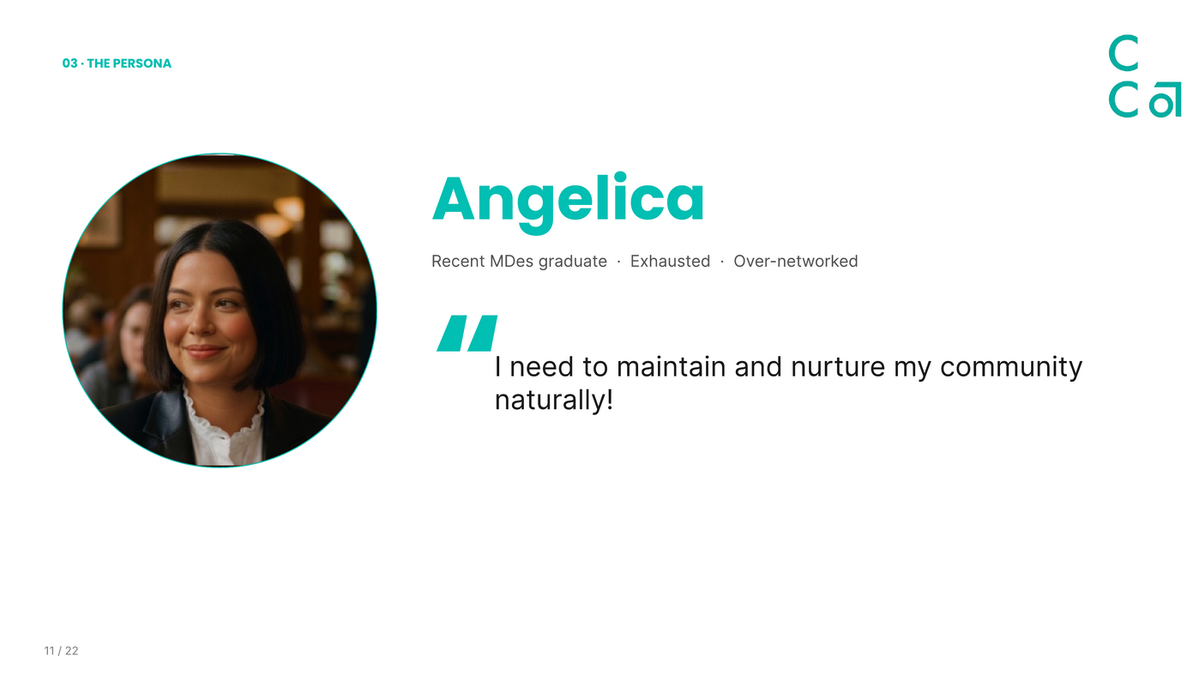
Payoff: advocating for real users! That research produced our persona, Angelica, a recent MDes grad. Her problem was not a lack of tools. Every tool failed her differently. That set the direction.
Start with CCA as a repeatable template. I am part of the community, so I could research it directly.
Hybrid onboarding
Decision: short form for facts, voice interview for the story.
Why: one input mode failed in testing, so I had the team pivot.
Bonus: pre-filled fields shrink the AI's error surface. The agent never wastes a turn asking for a graduation year.
Some of the team wanted voice-only. I fought for voice-first on accessibility grounds.
Voice adds latency and a permission ask, so it needs a clear "you can just type" fallback.
Privacy as primary input
Decision: How do we filter out cold DMs and adjacent-industry noise out of the process? By making consent the first thing you set, not the last.
Users write (or say during voice onboarding) plain-language visibility rules ("no recruiters, no adjacent industries") that the model reads.
The match becomes the filter.
Trust problem: people distrust AI, so hidden logic was a dealbreaker.
By making the match become the filter and positioning consent is the first thing you set, not the last.
Users needed a way to set their privacy settings in an individualistic way, so I architect a model so users could type/or speak free-text visibility rules interpreted by the model.
Fix: I pushed for a Privacy Insights view. It shows the exact rule that surfaced each profile and what was shared.
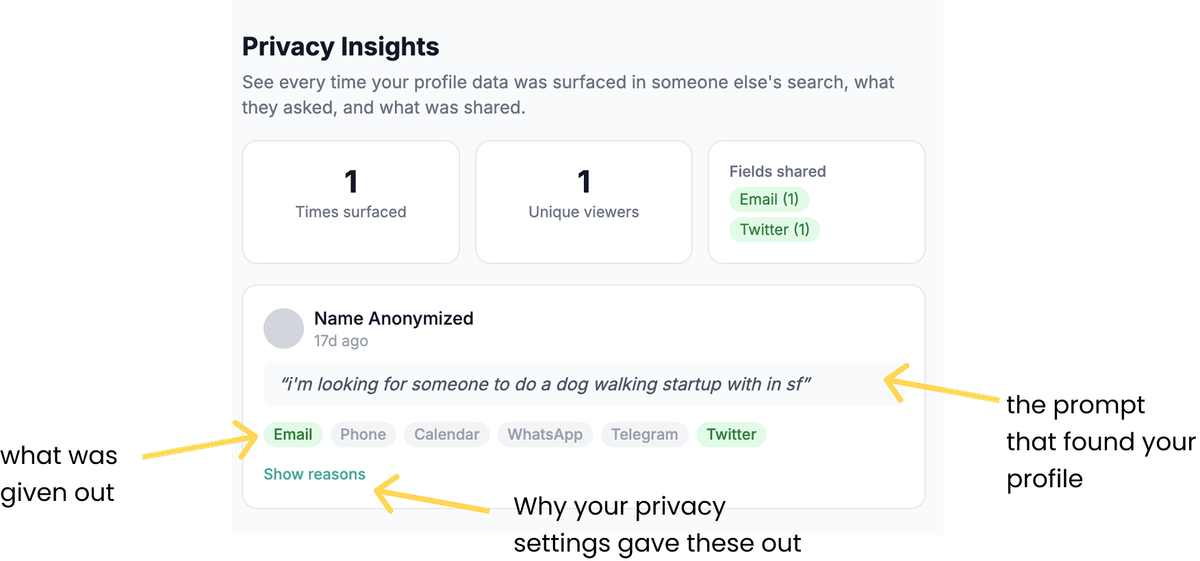
Result: once skeptics could see why, they trusted it.
Next: a preview that says "here is what this rule would share."
Agentic introductions
Decision: one life update should ripple automatically.
"Traveling to Berlin for 5 months" becomes an availability change, a match list, and a mentor notification.
Why: the follow-up burden is what makes networking feel like work.
Every match shows its reasoning, I made the decision to allow the user to see why a match was made.That became the key to trust. I would make it even more visible next time.
Build, test, and reflect
What I owned: user flow, user testing, advocating for the user and branding.
I mapped the networking chat, directory, matches, Privacy Insights, and events tabs, then ran onboarding tests from form through voice.
Result (honest): this is a prototype, so there is no live metric yet.
The clearest signal: AI skeptics started trusting the platform once Privacy Insights showed them why a match happened. If it shipped, I would track onboarding completion, match-acceptance rate, and privacy-rule edits.
The main thing I would change is workflow & collaboration with the team.
To combat this in the future I think I need to have science backed user insights and alignment documentation in my back pocket. Eng wanted to move so fast that they often forgot about the user.
For UX I would like to add privacy-rule confirmation previews.
It would be nice to take the time design explicitly for the cold-start (20 users vs. 2,000) because scaling for this project would probably require a rebrand based on research.
It’s also necessary to build full accessibility from day one, including parity, captions, transcripts, and non-audio flows into voice-first onboarding. Historically 3/5 CCA students struggle with some sort of disability, however that shouldn’t be the only reason.